Designing Accessible Spaces: Door Hardware Requirements Under AS 1428.1:2021
Designing Accessible Spaces: Door Hardware Requirements Under AS 1428.1:2021
As a leading supplier to Australia’s commercial, fitout and multi-residential sectors, ENTRO takes DDA and AS 1428.1:2021 compliance seriously. Accessible hardware is not just a regulatory consideration. It directly affects usability, safety and independence for many building occupants each day.
Below is a clear, practical guide to the key door-hardware requirements under AS 1428.1:2021, written for architects, designers and specifiers.
1. LEVER HANDLES
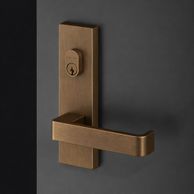
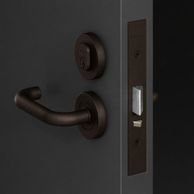
Lever handles remain one of the most intuitive and accessible hardware solutions for hinged doors. AS 1428.1:2021 outlines dimensional and performance criteria to support operation by users with varying mobility and hand strength.
Key requirements:
- Grip clearance: 35–45 mm
A clearance of 35–45 mm is to be provided between the handle and the door face or mounting plate, allowing a full hand to fit behind the lever. - Lever return: minimum 20 mm
The lever is to return toward the door so that the end of the handle sits at least 20 mm from the door face. This assists with control and reduces the risk of snagging. - Snib lever length: minimum 45 mm
Turn snibs are to project at least 45 mm from the centre of the spindle to allow adequate grip. - One-handed, non-slip operation
Door furniture is to be operable with one hand and without tight grasping, pinching or twisting of the wrist. - Opening force: maximum 20 N
The force required to initiate the opening movement, including latch release, is not to exceed 20 N. - Installed height: 900–1100 mm AFFL
The centre of the operable spindle, including snibs and privacy turns, is to be located between 900 mm and 1100 mm above finished floor level.
2. PULL HANDLES
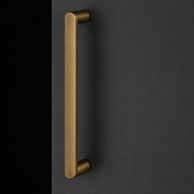
Pull handles provide a strong, positive grip on both hinged and sliding doors. AS 1428.1:2021 sets out requirements for clearance and positioning to support safe and consistent operation.
Key requirements:
- Grip clearance: 35–45 mm
A clearance of 35–45 mm is to be provided between the pull handle and the door surface. - Graspable area within 900–1100 mm AFFL
For vertical entrance pulls, a portion of the usable gripping surface is to fall within the 900 mm to 1100 mm accessible height zone. - D-type handles on sliding doors
Sliding doors are to be fitted with D-shaped pull handles that provide a continuous and secure grip suitable for one-handed operation.
When Offset Pull Handles May be Used:
Offset pull handles are not required on all accessible doors, but they may be appropriate when:
- A narrow stile places a centre-mounted handle too close to the frame to achieve the required 60 mm clearance
- Double sliding or double entrance doors require improved ergonomic spacing
- Locks or snibs require additional finger clearance around the hardware
Offset pulls can assist in achieving the necessary clearances in these situations.
3. SLIDING DOORS — CLEAR OPENINGS & CRITICAL CLEARANCES
Sliding doors are commonly used in accessible bathrooms, meeting rooms and internal fitouts. To align with AS 1428.1:2021, they require additional design consideration beyond standard pull-handle selection.
- Minimum clear opening: 850 mm
When fully open, the clear opening width is to be not less than 850 mm. - Minimum 60 mm clearance — open and closed
To allow safe gripping and prevent handle-to-frame collision: - A minimum 60 mm clearance is to be provided between the pull handle and the adjacent wall or door frame when the door is closed.
- A minimum 60 mm clearance is also to be maintained when the door is fully open.
These clearances help protect the user’s hand, allow comfortable gripping and prevent hardware obstruction.
4. DOOR CLOSERS
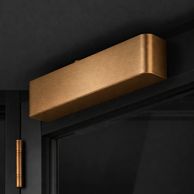
Door closers can significantly influence accessibility, particularly in relation to opening force.
AS 1428.1:2021 requirements:
- Opening force not to exceed 20 N
From 0° to 30° of opening, the force required to open the door is not to exceed 20 N. - Delayed action or hold-open
Where a closer is fitted to a door other than a fire door or smoke door, adjustable delayed action or hold open functionality may be used.
Why cam action closers are preferred
Cam action closers (e.g. the ENTRO D1203) generally provide reduced opening resistance compared with traditional rack and pinion closers. Their cam and roller mechanism delivers a more efficient opening profile, particularly in the initial stages of movement.
This can make cam action closers a practical solution when working to achieve the 20 N maximum opening force under AS 1428.1:2021, subject to door size, seals, hinges and overall installation conditions.
IMPORTANT NOTE: FIRE DOORS
Fire and smoke doors are not subject to the 20 N opening-force limit under AS 1428.1.
For life-safety reasons, fire doors are required to:
- latch positively
- resist air-pressure differentials
- maintain fire and smoke compartmentation
As a result, fire-rated doors commonly require higher closing forces than non-fire-rated doors. In many cases, this corresponds with a minimum Power Size 3 door closer, depending on the door configuration and fire requirements.
Accessible circulation should be provided via non-fire-rated alternative doors where required.
FINAL THOUGHTS
Accessible hardware plays a vital role in creating buildings that are safe, inclusive and future-ready. By understanding handle clearances, lever geometry, height positioning and door-closer performance, architects can specify hardware that aligns with AS 1428.1:2021 while delivering a better user experience across commercial and fitout environments.
If you need support reviewing hardware schedules or selecting compliant door sets, the ENTRO team is here to help.